
Advantages of magnesium alloys
Superior lightweight and high-strength solutions
Lightweight
Magnesium alloy has high strength per unit weight, making it suitable for manufacturing automotive components or thin and light electronic product casings.
Density
The density of magnesium alloy is 1.8g/cm³, 36% lower than aluminum alloy and 77% lower than steel. It is currently the lightest engineering metal material for applications.
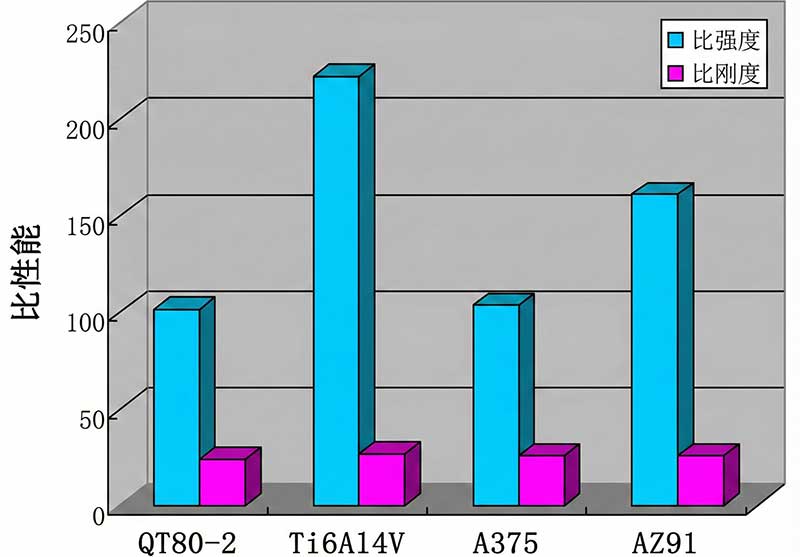
Specific Strength & Specific Stiffness
It has higher tensile strength and stiffness per unit mass than steel and aluminum, making it ideal for structural parts where weight and strength are comprehensively considered.
Damping Resistance
The damping coefficient is 20 times that of aluminum and more than 5 times that of steel.
Electromagnetic Shielding
As a non-magnetic metal, magnesium alloy can effectively prevent electromagnetic interference without additional electroplated shielding film.
Heat Dissipation
It has better convective diffusion and heat dissipation efficiency for heat sources than aluminum alloy.
Shock Absorption
It can effectively absorb vibration and noise.
Comparison of Lightweight Material Performance
| Material | Model & Specification | 45 Steel | ||
|---|---|---|---|---|
| Aluminum Alloy | Magnesium Alloy | Titanium Alloy | ||
| Density / g/cm³ | 2.7 | 1.81 | 4.4 | 7.85 |
| Tensile Strength / MPa | 310 | 250 | 980 | 850 (Normalized) |
| Specific Strength (Strength/Density) | 116 | 138 | 222 | 108 |
| Elastic Modulus / GPa | 71 | 45 | 110 | 210 |
| Specific Stiffness (Elastic Modulus/Density) | 25.9 | 25.86 | 25 | 26.75 |
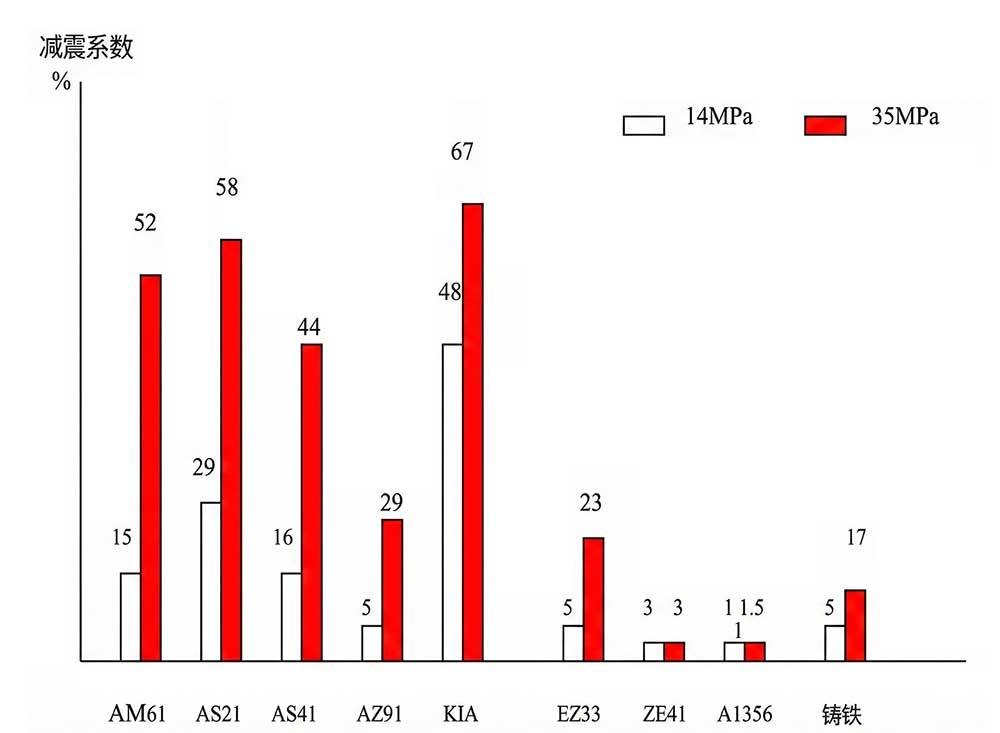
Shock absorption comparison
| Material | Cast Iron | Aluminum Alloy | Plastic | Magnesium Alloy |
| Damping Coefficient % | 10-17 | 2-5 | NA | 30-60 |
Comparison of electromagnetic shielding effectiveness
| Electromagnetic Radiation Frequency | Electromagnetic Shielding Effectiveness | Comparison | |
|---|---|---|---|
| Aluminum Alloy | Magnesium Alloy | ||
| 30 | 68 | 72 | +5.9 |
| 400 | 52 | 68 | +31 |
| 900 | 40 | 70 | +75 |
| 1200 | 32 | 68 | +112 |
| 1500 | 33 | 69 | +109 |